


Pick up a bag of specialty coffee and you might find more information on the label than you expected: country, region, farm, producer, altitude, variety, processing method, tasting notes, roast date — sometimes even a score.
All of that information can be useful. But not all of it matters equally, and none of it should make buying coffee feel like studying for an exam.
So here is our honest guide to reading a coffee bag: what each piece of information actually tells you, what it doesn’t, and what we think is worth paying attention to when choosing your next coffee.

Origin: start here
Ethiopia. Colombia. Kenya. Brazil.
The country is usually the first thing you notice, and it gives you a useful starting point — but only a starting point.
Coffee is an agricultural product, and countries can contain an enormous range of climates, elevations, varieties and processing traditions. Saying that you like “Colombian coffee” is a little like saying you like “French wine.” It tells us something, but not nearly everything.
That is why you will often see increasingly specific information underneath the country:
Country → Region → Farm / Washing Station → Producer
The further down that chain you can go, the more traceable the coffee becomes.
It also means that if you find a coffee you really love, you have something more useful to remember than simply the country it came from.
Producer or farm: the name isn't there just for storytelling
On many specialty coffee bags you'll see the name of a farmer, farm, cooperative or washing station.
We think this is important.
Coffee doesn't simply come from “Kenya” or “Colombia.” Someone grew it, harvested it and made decisions about how it was processed. Putting that information on the bag gives credit to the people behind the coffee and gives you a better understanding of exactly where it came from.
It also makes coffee easier to follow from year to year. If you loved a particular producer's coffee this season, seeing their name again next harvest might actually tell you more than seeing the same country printed on another bag.
Variety: think grape varieties, but for coffee
Bourbon, Caturra, SL28, SL34, Typica, Gesha, Pink Bourbon.
These are coffee varieties.
You don't need to memorise them, and seeing a famous variety on a bag doesn't automatically mean the coffee will be exceptional.
But variety does influence how coffee can taste.
Some varieties are known for floral character, others for sweetness, acidity, body or particular aromatic qualities. At the same time, variety is only one part of the equation. Where the coffee was grown, how ripe the cherries were when picked, how they were processed and how the coffee was roasted all matter too.
So treat variety as a clue, not a guarantee.
If you notice that you keep enjoying SL28 coffees from Kenya or Pink Bourbon from Colombia, however, that's useful information. Remember it.

Altitude: higher doesn't automatically mean better
You might see something like:
1,800–2,000 MASL
MASL simply means metres above sea level.
Higher elevations often mean cooler temperatures and slower cherry development, which can contribute to denser coffees with greater sweetness, acidity and complexity.
But this is where coffee labels can become misleading.
1,800 metres isn't a universal quality score.
Climate changes from country to country and even from one side of a mountain to another. A coffee grown at 1,200 metres in Brazil shouldn't automatically be considered worse than one grown at 1,900 metres in Ethiopia.
Altitude becomes much more useful when you're comparing coffees from similar regions.
So yes, look at it — just don't buy coffee purely because the number is bigger.
Processing: one of the most useful things on the bag
If there is one technical detail worth learning, it might be this one.
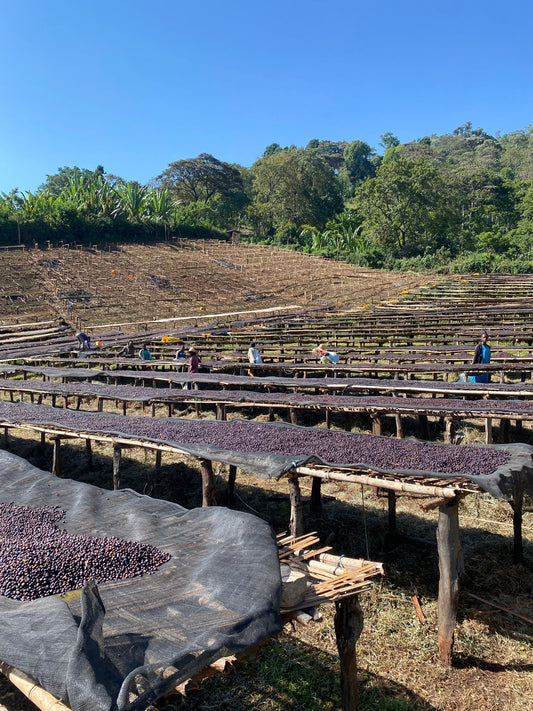
After coffee cherries are picked, the seeds we eventually roast have to be separated from the fruit and dried. How that happens can dramatically influence what you taste.
You'll most commonly see:
Washed — usually cleaner and more transparent, often with more clearly defined acidity.
Natural — the coffee dries inside the fruit, often creating more fruit-driven flavours, sweetness and a heavier body.
Honey — some of the fruit mucilage remains around the seed during drying, often sitting somewhere between washed and natural in character.
And then there are increasingly common experimental processes:
Anaerobic, carbonic maceration, extended fermentation, thermal shock and many variations in between.
These can create much more intense and sometimes unexpected flavour profiles.
But “experimental” doesn't automatically mean better.
A complicated processing method can produce an extraordinary coffee. It can also simply produce a very fermented-tasting coffee.
The name of the process tells you what happened to the coffee, not whether the result was good.
That part still has to be decided in the cup.
Tasting notes: no, we didn't put blueberries in your coffee
Jasmine. Peach. Blackcurrant. Chocolate. Caramel.
This is probably the most misunderstood part of a coffee label.
When we write these words on a bag, they are not ingredients.
Nothing has been added to the coffee.
They are sensory references — flavours and aromas our team noticed while tasting the coffee.
Think about wine. A bottle might be described as having notes of cherry or vanilla without containing either ingredient. Coffee works in much the same way.
More importantly, tasting notes shouldn't be treated as a promise that everyone will taste exactly the same thing.
You might read peach, jasmine and honey and taste something closer to apricot and black tea.
That's completely normal.
The notes are there to point you in a direction.
A simple way to use them
Instead of asking:
“Will I actually taste strawberry?”
ask:
“Does this sound fruity, floral, chocolatey, nutty or more traditional?”
That is usually much more useful when choosing a bag.
Roast date: fresher isn't always better
This one surprises people.
Coffee doesn't necessarily taste best the day after it was roasted.
Freshly roasted coffee releases a significant amount of CO₂, and many coffees benefit from resting before brewing. Depending on the coffee, roast profile and brewing method, that can mean several days or considerably longer.
So when you see a roast date, don't automatically reach for the newest bag on the shelf.
The roast date is there primarily to tell you when the coffee was roasted, not to create a countdown where every passing day makes it worse.
Coffee changes after roasting. The goal is to drink it within a useful window, not five minutes after it leaves the roaster.
Roast level: useful, but less precise than it sounds
Light. Medium. Dark.
These terms seem simple, but there is no universal definition that every roastery follows.
One roaster's “medium” might look surprisingly light next to another roaster's medium.
That is why we think roast level is best treated as a general indication of style rather than an exact measurement.
As a rough guide, lighter roasting tends to preserve more of the characteristics of the coffee itself, while darker roasting introduces more flavours created by the roasting process.
Neither is automatically better.
The question is what you actually enjoy drinking.
Cup score: probably less important to you than you think
Occasionally you'll see numbers like:
86 points. 88 points. 90+ points.
These scores come from professional coffee evaluation systems and can be useful within the industry when producers, buyers and roasters evaluate and compare coffees.
But a higher number doesn't automatically mean you will enjoy that coffee more.
An extremely complex 90-point coffee might be fascinating on a cupping table and still be less enjoyable to you every morning than a sweet, balanced coffee with a lower score.
Quality and preference aren't exactly the same thing.
If a score is provided, use it as additional information — not as the reason to buy the coffee.
So what should you actually look at?
If you're standing in front of a shelf and don't want to analyse ten different variables, keep it simple.
Start with tasting notes. They give you the quickest indication of the general direction of the coffee.
Then look at processing. Washed versus natural can tell you a lot about what kind of cup you might be getting.
Look at origin and gradually start remembering the countries, regions and producers you enjoy.
After that, variety, altitude and all the other details become useful ways to understand why you liked something.
You don't need to learn everything before you can enjoy specialty coffee.
You learn it by drinking it.
The label is a map, not a guarantee
That's probably the most important thing we can tell you.
A coffee bag label can't tell you whether you'll love the coffee inside.
A famous variety doesn't guarantee an extraordinary cup. Higher altitude doesn't automatically mean higher quality. An experimental process isn't necessarily more interesting. And a tasting note isn't a flavour ingredient or a promise.
All of these things are clues.
Together, they tell you where the coffee came from, who produced it, what happened to it before it reached us, and what we found when we tasted it.
And over time, those clues become genuinely useful.
You start noticing that you prefer washed coffees. Or natural Ethiopias. Or Colombian coffees with more traditional profiles. Or bright Kenyan lots that taste almost nothing like what you once thought coffee was supposed to taste like.
That's when the information on the bag stops looking like coffee-industry jargon.
It starts becoming a way of finding the next coffee you'll actually want to drink.


